Skip to content
Analytical equipment and technology
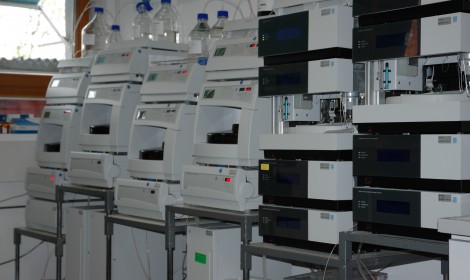
- Analytical HPLC and UHPLC (e.g. normal phase, RP-, ion pair chromatography), Ph.Eur.
- isocratic, binary and trivalent high pressure gradient systems
- column switching
- cooling sample-compartment
- DAD, UV/Vis-, RI and Fluorescence-detection
- GC / MS equipped with headspace, Ph.Eur.
- N2 and He as carrier gas
- FID, MS-detection
- Dissolution tester (e.g. paddle, basket, use of sinker), Ph.Eur.
- Permeation testing by Franz-Cells
- TLC, Ph.Eur.
- Computer-controlled titration (Titrino, e.g. Karl Fischer), Ph.Eur.
- UV/Vis-spectroscopy, Ph.Eur.
- FTIR, Ph.Eur.
- Gel chromatography (SEC), Ph.Eur.
- Potentiometry, Ph.Eur.
- Pharmaceutic-physical investigations (e.g. resistance to crushing, friability, disintegration, weight variation), Ph.Eur.
- Loss on drying, Ph.Eur.
- Determination of sub-visible particles by
- Light obscureness, Ph.Eur. – Method 1
- Microscope, Ph.Eur. – Method 2
- Monitoring by light scattering (PCS) of nanoparticles and emulsions for parenteral application
- Sieve analysis, Ph.Eur.
- Bulk density / Tapped density, Ph.Eur.
- Osmolarity, Ph.Eur.
- Viscosity, Ph.Eur.
- Melting point, Ph.Eur.
- Optical rotation, Ph.Eur.
- Refractometry, Ph.Eur.
- Density Ph.Eur.
- Biochemical methods, e.g. Electrophoresis technology, Western Blot, SEC